Nov 3, 2026 |
KAMBAKU celebrated its 2nd anniversary and brought together Gorongosa National Park and the Mozambique Wildlife Alliance for a debate on artificial intelligence and conservation in Maputo.
The Knowledge Circle “Who Programs Nature?”, facilitated by the KAMBAKU team, took place last Thursday, 29 October, on the seventh floor of the JFS Tower in the capital’s Baixa. The gathering brought together biologists, conservation managers and educators for a conversation on how sensors, data and artificial intelligence are supporting wildlife protection today.
Hugo Pereira, of the Mozambique Wildlife Alliance (MWA), brought to the circle the experience of using GPS platforms to manage conflict between people and wildlife, one of the problems that weighs most heavily on communities living alongside conservation areas.
For her part, Wanda Veríssimo, human resources director at Gorongosa National Park, spoke about training young Mozambicans in science applied to biodiversity, sharing the experience built up by the Restoration Project over recent years, with particular emphasis on the Edward O. Wilson Biodiversity Laboratory, a scientific research centre located in Gorongosa.
One of the pillars of this investment is Gorongosa’s Master’s in Conservation Biology. Created in 2017 with support from the Howard Hughes Medical Institute, the programme is run with Lúrio University, Zambeze University and the Higher Polytechnic Institute of Manica, in partnership with the University of Lisbon, and applications are open until 3 November for its fifth intake, with twelve fully funded places.
With no stage and the speakers seated at the same level as the audience, the session was moderated by Isildo Nhatumbo, of KAMBAKU. José Maria Langa, of KAMBAKU and ObservA, took part remotely and presented the concept of Con(pre)servation, which gave its name to KAMBAKU’s view of the relationship between technology and conservation in Mozambique.
Part of the Knowledge Circle “The Ecological Mirror”, the conversation started from the idea that nature increasingly reaches us filtered through technology, from the GPS collar that reveals an elephant’s position to the sonar that counts whales or the forensic science that identifies a poacher. Under discussion was who controls, who produces and who can afford this mirror, and what image of natural Mozambique we want to see reflected in it. Part of the session was set aside for questions and testimonies from the audience, both in person and online.
The session closed with a toast to KAMBAKU’s two years, as set out in the festival programme.
The Knowledge Circle was one of 21 that made up this year’s edition of Maputo Fast Forward, which marked ten years of the festival under the theme “Artificial Realities. The Infinite Mirror”. Between 23 October and 1 November, the programme also included conferences, exhibitions, performances and concerts, with names such as Mia Couto and, on the panel dedicated to ecology, Fátima Mimbire, Fadhel Kaboub and João Camargo.



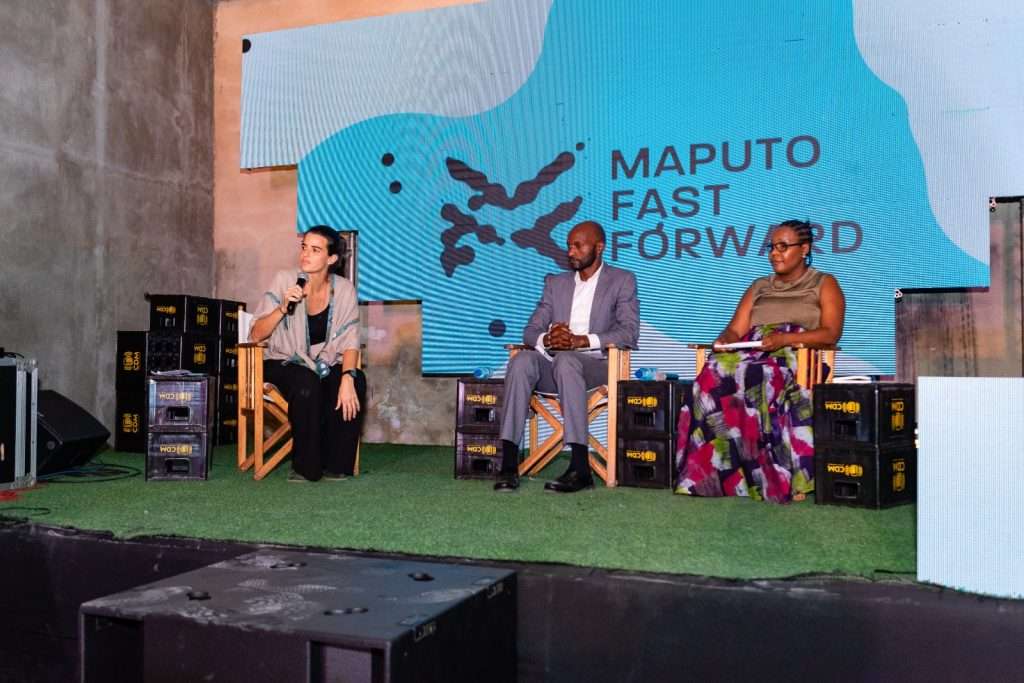
Photo: MFF 2026