Abr 28, 2026 |
Researchers who discovered four new species of chameleon in the Namuli, Inago, Chiperone and Ribáuè Mounts warn that these species are already at high risk due to the loss of forest habitat.
The warning comes just a few years after the expedition carried out between 2014 and 2018 in the isolated mounts of northern Mozambique, located in the province of Zambezia, which revealed the existence of four previously unknown species of chameleons of the genus Nadzikambia, each confined to a single ‘island in the sky’, as these biodiversity-rich rock formations are known.
The findings confirmed that the ecological isolation of these mounts—Namuli, Inago, Chiperone and Ribáuè—has favoured speciation processes among the local herpetofauna, giving rise to unique lineages of reptiles, including forest chameleons found nowhere else.
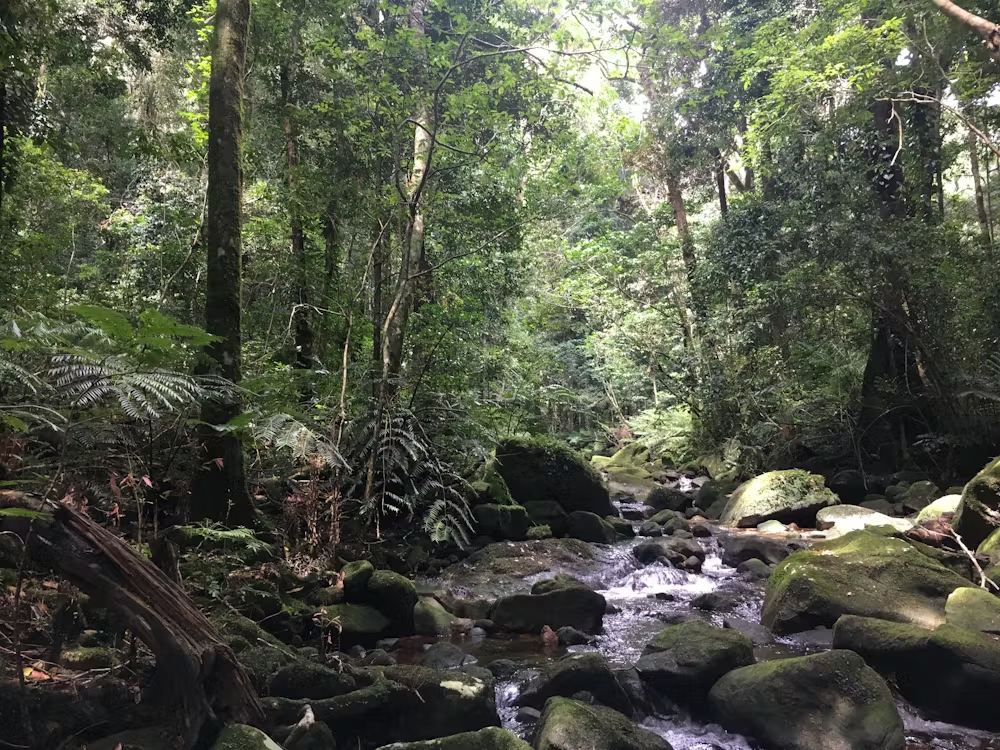
These formations, granite massifs rising abruptly above the savannah, create humid microclimatic conditions that sustain dense and highly specialised tropical forests within a predominantly arid regional context.
According to Krystal Tolley, who, together with Werner Conradie, led the expedition, despite the taxonomic significance of the discoveries, the data point to a critical situation. Habitat destruction caused by slash-and-burn agriculture has drastically reduced the extent of the montane forests.
As she writes in The Conversation, in some cases, it is estimated that between 80% and 90% of the original forest cover has been cleared over the last few decades, compromising the viability of the newly described populations.
Forest chameleons exhibit behaviours and adaptations that make them difficult to detect, including effective camouflage and a tendency to remain in the upper canopy. Locating them required intensive night-time surveys under adverse logistical conditions, with no defined trails or access to communications, underscoring the exploratory nature of these expeditions.
The four species were formally described and named with the aim of highlighting both historical scientific contributions and the urgency of conservation. Among them, Nadzikambia goodallae, from Mount Ribáuè, pays tribute to Jane Goodall, whilst Nadzikambia franklinae, from Mount Namuli, recognises Rosalind Franklin and the importance of genetic analysis in confirming these species.
The species Nadzikambia evanescens, from Mount Inago, refers to the progressive loss of habitat, whilst Nadzikambia nubila, from Mount Chiperone, reflects the atmospheric conditions characteristic of this ecosystem.
Three of these species are considered to be at high risk of extinction, mainly due to the rapid conversion of forest to agricultural use. In contrast, Mount Chiperone presents a relatively more stable scenario, given that the local forest is protected by the community’s cultural practices, which regard it as sacred.
In a broader context, it is estimated that around 25% of African tropical forests have been lost since 1990, whilst globally almost 30% of tropical forests have been destroyed or severely degraded over the same period. This situation, combined with our still incomplete understanding of biodiversity distribution, suggests that many species may disappear before they are scientifically documented.
Main photo: Male sylvan chameleon (Nadzikambia goodallae) from Mount Ribáuè. Image credits: Krystal Tolley and The Conversation